Poultry Behaviour
Poultry Behaviour
Knowledge of the behaviour of the stock and the application of that knowledge in the care of the stock plays an important part in the maximisation of production efficiency of a poultry production enterprise. In addition, the management of the domestic fowl has received considerable attention over recent years from the community, particularly animal liberation groups, because of the way that commercial poultry management systems have intensified. As a consequence, the study of poultry behaviour is important to the unit manager, not only to ensure that the welfare of the birds and production efficiency are maintained but also to minimise the influence of what is often uninformed debate. Behaviour is the way that animals respond to the different stimuli they encounter in their environment. The stimuli may be from other birds, their environment, people or any other thing or occurrence.
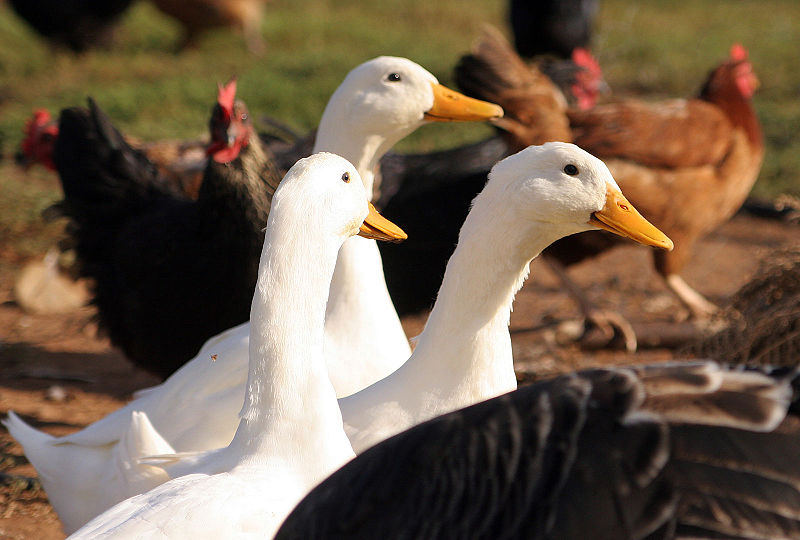
Ducks amongst other poultry
General behaviour
The domestic fowl by nature is a wary, shy animal with limited ability and short-term flexibility. However, in the longer term, it displays a good ability to adapt to different circumstances and changing conditions. It has excellent vision and hearing, but its other senses tend to be poorly developed. In the wild state it lives on the jungle floor in a thick forest habitat and its behaviour tends to fit into that niche. Here it uses the ground space for foraging, dust bathing and nesting. At night it perches in the trees for protection against ground predators. A number of these behaviour activities are innate (inborn) and it is believed that the inability to carry them out may lead to a state of frustration.
Social behaviour
Fowls are a gregarious species with an elaborate social behaviour based on a definite group structure when kept in flocks. They maintain personal space by communication via postural changes. Important signals are associated with the position of the head and the relative angles of the head and the body to other birds. They maintain contact with flock mates by sight up to intermediate distances and by vocal communication at longer distances or if out of sight. The wild and/or feral male establishes a territory with his harem. Subordinate, unattached males occupy the same territory so long as they adopt a subordinate relationship to the dominant male. However, these subordinate males do most of the crowing while the dominant male suppresses all hens fighting in the vicinity.
Breeding behaviour
The hen is a seasonal breeder and is secretive about its nesting site. It lays on a 23 to 26 hour cycle and produces up to 10-15 eggs before incubating them constantly with only one major daily break for feeding and plumage care. The male mates regularly with the hen and also acts as an escort to and from the nest. On hatching, the chickens rapidly imprint (bond) onto the hen. They move about with her, initially staying quite close and are brooded very often. As they grow and their need for brooding diminishes they range further and further from the hen. Her brood remain living on the ground until the chickens are about 6 weeks of age when the hen re-commences to roost, encouraging the chickens to join her. When the chickens are about 10 to 12 weeks old she starts the weaning process by driving the chickens from her. When they are weaned by about 16 to 18 weeks the hen re-joins the harem and the chickens join the juvenile flock.
Factors governing behaviour responses
There are a number of factors that influence the behaviour responses of fowls to any stimuli. These are:
- Genetic – the bird’s genetic make-up has an important influence on its reaction to any stimuli. Some strains are more docile than others and this characteristic responds to selection pressure. In a similar way, fowl can be selected for a number of behavioural characteristics, some considered to be quite important in their management.
- Experience – while much of their behaviour is innate, there is that which has to be learned. Chickens know instinctively how to eat, but they do not know what to eat or where to find it. In the natural situation, the hen teaches her brood what to eat and where to find it.
- Age – in addition to the need to learn many aspects of their behaviour, age has another implication. Certain behaviour is not expressed until the chickens reach appropriate ages. Examples of these behaviours include the development of the peck order and reproduction behaviour.
- Environment – the environment plays an important part in the way chickens respond or behave. High light intensity tends to increase activity which is a beneficial response in very young chickens in encouraging them to seek food and water. However, in older birds it can lead to harmful behaviour such as cannibalism.
Sight
The sense of sight is good with the embryo showing its first reaction to light at about day 17 after the start of incubation. Fowls have little mobility of the eye and while they have approximately 300° of vision, only 26° are binocular. Fowls have excellent sharpness of vision (acuity). They see colour in much the same way as humans and, like humans, are most sensitive to green. However, chickens prefer blue objects with red being the next preferred followed by orange and green. The contrast in colour is very important in attracting chickens e.g. to food and water.
The threshold of activity (the intensity of activity under normal circumstances) is believed to be higher than for humans and this is used as an aid for flock management by scheduling handling procedures at night whenever possible (when the birds are at rest and least active). The colour of light influences some behaviour and aspects of production efficiency but white light is generally preferred because it requires less power to achieve a given intensity and hence is more cost effective.
Smell
It is believed that fowls have very limited smelling ability because they are not repelled by obnoxious odour.
Hearing
The fowl’s ear is well developed but does not include an ear lobe or pinna. It is located behind the eye and a tuft of feathers protects the opening. Calls in the range of 250 to 3000 hertz are used in vocal communication. A large number of calls by chicks and adults have been identified. Chickens are attracted to sounds that have a low frequency, short duration and which are repetitive i.e. the sound of a broody hen clucking to her chickens. A chicken in distress gives a loud, high frequency call.
Taste
Fowls have approximately 300 taste buds and they discriminate between strong tasting compounds, particularly in the drinking water. They will reject water that is above approximately 32°C although they will drink very cold water.
Touch
Birds are highly responsive to touch. Females will often adopt a sexual crouch when touched on the back.
Learning Ability
While much of the fowls’ behaviour is inherent, they do need to learn in order to survive. Individuals will copy others and this is an important part of the learning process. When a bird sees another pecking at something, it will copy, thus learning what to eat, and where to find food (and water).
Fowls are highly adaptable and become conditioned to many environmental and management situations. Training in relation to a number of management requirements is an important part of flock management. Fowls soon learn to pull, tug, peck, and scratch and their nature is such that they will remain at these tasks for lengthy periods. They are good at visually discriminating tasks and tend not to generalise, i.e. they stay at the task at hand without becoming bored or becoming side-tracked. This limited flexibility means that they adapt to intensive forms of housing very easily and quickly unlike those species which do generalise and which do get side-tracked and bored.
Social behaviour
There are a number of factors that influence social behaviour. These include:
- Individual recognition
- Communication
- Pecking and the peck order
Individual recognition
Fowls recognise each other by appearance based on the shape of the comb, wattles and head generally. Colour changes in plumage are identifiable, with intense colours being more noticeable than lighter or those with a washed appearance. Only very abrupt, major changes result in a failure to recognise flock mates that have been altered. However, they forget each other fairly quickly. Members of flocks that are broken up forget each other within 3 to 4 weeks.
Communication
The fowl uses a variety of sounds in order to communicate with other fowls. The most commonly used are food calls, predator alarm calls, pre- and post-laying calls and rooster crowing. Chicken distress calls draw immediate attention from their broody hen. The clucking calls of the broody hen to her brood will result in all of the chickens gathering close to her. They will respond to these calls even played as a recording.
Fowls communicate also with others by displays and changes in posture such as head up or head down, tail up or tail down, or feathers spread or not spread. Displays play an important part in mating behaviour. Thus communication plays an important part in the maintenance of individual personal space, flock organisation and integrity in a group situation.
Pecking and the peck order
Pecking as a skill is recognised as being species specific for fowls. They peck to escape from the shell, to feed, to drink, to obtain and keep personal space and to establish relationships as well as for other reasons. Hens maintain a personal space around their heads and keep a distance from each other by holding their heads at an angle and maintaining a specific body orientation or angle to other birds. If a direct head to head stance is adopted, pecking will usually result.
Submission is usually demonstrated by escape or crouching. However, the main purpose of pecking is for eating which is a precisely tuned movement of the head and neck. The food is picked up by one action and swallowed by another. Beak trimming changes the relationship between the top and bottom beak and, in so doing changes their ability to peck. They can no longer pick food particles from hard, flat surfaces and, consequently, food and water troughs must carry an adequate depth of food and water to ensure that the birds are able to obtain a sufficient quantity of both.
The pecking habit is used to establish a hierarchical organisation or ranking structure in the flock of dominant and progressively subordinate members. This organisation is established separately for males and females in the same flock. Called the peck order, the organisation commences at an early age and, depending on flock size and complexity, will be established by 10 to 16 weeks. This process follows a well-recognised sequence:
- For day 1 to 3 there is a strong imprinting or bonding period when the newly hatched chicken bonds onto the broody hen. In commercial situations they bond onto other objects and, because of this, are more easily trained.
- This is followed fairly quickly by the development of escape behaviour – a protective mechanism.
- Shortly after, the first signs of aggressive behaviour are seen. Two chickens approach each other aggressively and then, before contact is made they race away i.e. escape.
- This stage is followed by a period of play fights where they spar but do not make real contact.
- The final stage is where real contact is made and is the truly aggressive stage. It is from these true fights that the dominant/subordinate relationships are established. The age that this is completed depends on the size and complexity of the flock but in most cases would be sometime after 10 weeks of age.
- A separate peck order is established for males and females in mixed sex flocks.
Once established the birds live in a harmonious state with no obvious dominant/subordinate relationship until the flock structure is altered. In the practical situation, the manager must give consideration to the various aspects of the social organisation of the flock in order to minimise the disturbance of established relationships at those times when performance could be affected. Some key points in this aspect are:
- Form new groups of hens before production starts, ie. move new layers into the laying house before production is due to start.
- Do not move single birds or even small groups of birds from one flock to another.
- Provide adequate space needs – floor, eating, drinking and, if appropriate, nesting space.
- If it is necessary to join two groups, do so by separating the pen into two with wire netting and housing the groups, one on each side for a few days. Provide food and water for each group. After an appropriate time open the netting barrier a small amount to allow the two groups to mingle gradually. If the two groups are combined immediately the conflict that will probably develop will result in a significant number being injured by pen mates.
- Run males together as a group before placing them in the breeding pens.
- Place a male in with a group of females to reduce pecking (this will produce some fertile eggs).
Roosting and perching
The desire to roost or perch above the ground is an inherent protective mechanism against ground predators. However, modern commercial stock do not necessarily seek to use perches when provided with them. This indicates that, in these strains, the urge has been weakened and some managers believe it is unnecessary to provide roosts or perches. There is strong evidence, however, that layer and breeder replacements can be trained to better use nests thus reducing the number of floor eggs if platforms carrying food and water are located in pens of growing replacements.
The inclusion of roosts or perches and direct entry to nests from them in the laying house will also reduce the number of floor eggs in most cases. The development of the ‘perchery’ system of housing is aimed at using the inherent behaviour to perch. The perchery permits a significant increase in the number of birds that will comfortably occupy the house. Another important benefit of perches in the pen is to provide a place of escape from harassment from pen-mates during periods of light.
Preening and other behaviour
This is another example of inherent behaviour and has the function of maintaining feather condition. These activities include dust bathing, oiling (of the feathers from the uropygial or preen gland) and preening with the beak or foot. Dust bathing is claimed to be a behaviour need of hens which both rids them of external parasites and aligns their feathers. Failure to dust bathe is believed to lead to frustration.
Eating (maintenance) behaviour
At hatching, chickens inherently know how to peck and they can pick up objects i.e. eat. However, they do not know how to discriminate between what they should or should not eat. It is largely by trial and error that they find out the difference. Therefore, the first feeding experience should provide easy access to feed and deny access to materials other than feed. The normal practice is to place paper on the floor of their accommodation and to sprinkle a small quantity of feed on that for the first 24 hours. The paper is usually removed after about 3 days. It is also a normal practice to place feed in large, shallow trays called scratch trays or chick-type feeders for the first 7 – 14 days.
Feeding chicks
When reared by a hen the chickens’ feeding problems are greatly reduced because the hen shows them what to eat and what not to eat. She does this by example and vocal calls. There are a number of feeding systems that may be used by the poultry manager to feed the stock. Fowls are able to adapt to different types of feeders very easily provided the opportunity is given to do so progressively when changes are made. Therefore, once the chickens have learnt to discriminate between what is food and what is not, feeding systems can be changed and those systems can be operated at a height to minimise wastage and to fit other management requirements. Fowls are very adept at moving food particles with their beak. This can lead to selectivity of larger particles or in excessive wastage of feed (up to 10%). The problem of selectivity is overcomed by preparing the feed in finer form (but not too fine) or by pelleting. Placing a mesh on top of the food after filling can reduce food wastage from manually filled troughs. The mesh (recommended size 25 – 30 mm) prevents the birds from flicking feed particles and thus reduces feed wastage.
Feed intake
There are a number of factors that will affect a bird’s voluntary feed intake. Commercial poultry are usually fed a mixed feed that supplies the proper balance of nutrients, however poultry have the ability to balance their own dietary requirements if the main ingredients are provided separately in different receptacles. The materials supplying the major nutrient groups are provided independently and the hens eat sufficient quantities of each to satisfy individual needs. The feed pattern for fowls is to eat small quantities frequently. However, their crop provides them with a good storage capacity and consequently, there is no relationship between the length of time between meals and the amount eaten. Even if deprived of feed for several hours they can consume more when the feed is available and store it in the crop until required.
Drinking (maintenance) behaviour
Chickens initially approach the water because they are attracted to some physical aspect of it. For example, a bubble or dust settled on the surface. The mirror surface of very still water is less likely to attract them. Chickens hatched in incubators operated at low humidity or high temperature, or from eggs with thin shells, or where the eggs have been incorrectly stored prior to setting are likely to be dehydrated on arrival on the farm. High early brooding temperatures add to these effects. It is, therefore, imperative that they are given a drink as soon as possible after their arrival and that easy access to clean, cool, good quality water continues throughout their life.
Once they have learned where to find their water, the drinkers should be adjusted for depth and height to ensure that spillage is kept to a minimum. The recommended depth is up to 1 cm and the height of the lip of the trough level with the bottom of the birds’ wattles. It is important with young chickens newly placed in the brooder that they be attracted to the drinkers. It is thought that troughs are better for day olds than are bell type drinkers for this. Bottles are also better than bells. Important features of drinkers is colour contrast (e.g. the yellow and red of bottles), and a drinker lip height of less than 6 cm (i.e. not too high for them to see the water).
Water consumption and maximum temperature
Water consumption increases with egg production and with temperature. High environmental temperature causes the birds to commence panting in an effort to increase the elimination of body heat by the evaporation of water from the surfaces of the respiratory organs. If this did not occur the bird’s body temperature would increase until it became overly stressed and died from heat prostration. Therefore, the availability of good quality, cool, clean water is of the utmost importance in hot climates. Drinker systems that supply enough at lower temperatures may not be adequate at high temperatures. It should be noted also that poultry do not drink water that is over approximately 32°C.
If the change is progressive, fowls will adapt to different types of drinker systems. Sudden changes may result in some birds failing to learn how to use the new system for some time. Recent research has shown that the type of drinker is not as critical as the availability of the water. The water and food should be co-located in the pen. Domestic fowls are discriminating in relation to taste in the water. They are likely to reduce consumption when the water’s taste is too strong which could have serious effects when using the water as a means of administering some medication.
Reproduction behaviour
Males usually reach sexual maturity at 16 weeks and this will vary greatly with management and breed strain. Nutrition and lighting programs are of great importance in this respect, especially with modern commercial strains. Meat chicken breeders have been bred to mature at an older age than egg layer stock. Although there is significant variability because of genotype, the following conditions are important to consider when aiming for good mating performance from males:
- The males have had previous mating experience.
- Light breed males are more active than heavier genotypes but produce semen with lower sperm counts.
- Females will usually crouch more frequently for younger males that, in turn mate more often.
- Higher socially ranked males mate more frequently initially, but this advantage is short lived.
- Most mating occurs after mid-afternoon.
- Mating ratios – 8-10 males per 100 layer type females and 10-12 males per 100 for meat type breeders.
- Increasing day length will stimulate semen production although sufficient is produced on normal day length.
- Water deprivation for 48 hours or longer will lead to a lower semen production for up to 6 weeks.
- High iodine intake in excess of 5,000 ppm causes a reduction in sperm quality.
- Mouldy food, if eaten, may result in a lower sperm quality.
- Males will mate many times during the day but many of the latter matings will be dry.
Courtship and broodiness
Males and females have an elaborate courtship sequence prior to mating. In a free-living situation females will commence mating behaviour as young as 18 weeks although this depends also on genotype, sexual maturity, nutrition and environmental factors. High status birds crouch less frequently than do lower status birds. Broodiness describes the changed state in the hen when egg laying ceases and the incubation of the eggs and subsequent mothering of the chicks begins. While the onset of this stage is controlled mainly by hormonal mechanisms, the presence or absence of the broody trait cab be controlled genetically. Most modern commercial strains have been selected for non-broodiness because, when in the broody state, the hen ceases to lay.
Hatching synchronisation and vocalisation
Activity that is of a behavioural nature can be detected in the incubating egg from about the 17th day. The embryo is, at this stage, located so that its head is under the right wing and the beak is directed towards the aircell in the large end of the egg. Just prior to hatching the beak pierces the aircell and pulmonary respiration commences. At this stage the chickens commence vocalisation that acts as an auditory stimulus for the synchronisation of the hatching process. This synchronisation is enhanced if the eggs are in contact with each other.
Imprinting period
The chicken escapes from the shell by piercing it with its beak and then contines to break through the shell as it rotates around the egg until the two parts separate and the embryo escapes. A hen will usually accept strange chickens in her brood during the first 3-5 days (i.e. the more intensive part of the imprinting period). After that she is likely to reject them.
Nesting behaviour
In the free-living state hens select a nesting site with great care, often accompanied by a male if there is one present. Nesting is characterised by secrecy and careful nest concealment. Nesting behaviour has four stages:
- Seeking a place to lay – a quite protracted activity as she becomes restless, and paces about giving pre-laying calls and showing characteristic body postures. In litter houses she will often examine the walls and corners.
- Inspecting a number of nest sites before selecting one and entering it.
- Settling, squatting and forming the nest by rotating her body several times, she usually stands to expel the egg.
- After laying she examines the egg and leaves the nest, cackles and joins the rest of the flock.
- The cackle will often bring a male back to her if such is possible. Mating often occurs at this time.
Nesting behaviour in cages
Hens housed in cages try to adopt the same procedure, but because of the restrictions applied by the cage, she cannot and consequently is believed to suffer a degree of frustration which is demonstrated by the display of non-adaptive behaviour. She searches the cage, and pushes other hens away till she settles. The time spent in laying is often a period of harassment from other hens. Some hens will squat to expel the egg while others stand. The position adopted influences the number of cracked eggs – eggs expelled while standing are more likely to be cracked.
In wild flocks, nests are made on the ground in the semi-darkness of deep shadow. Where hens are housed in systems other than cages, they often select sites other than those provided i.e. they lay on the floor rather than in the nests. A minimum of one nest is required for each 5 hens and these should be available before the hens start to lay. Significant improvements in labour efficiency can be achieved by having the nests at a convenient height for the stock persons to collect from. It is therefore important that the eggs be laid in nests provided and not on the floor of the house. To avoid this, it is necessary to train the birds during the growing phase to use platforms off the ground. All nests should be at floor level at the start of laying and raised progressively once production has started and the birds are using the nests. All attractive floor-nesting sites should be eliminated.
Floor eggs
Hens will use single and/or community nests although timid birds are less likely to use the community type. In any one flock it is likely that both types will be found and hence better control of floor eggs may be achieved by giving the birds a choice of nest type. The following recommendations will help reduce the number of floor eggs produced by a flock:
- Fence off the corners of the pen and eliminate any dark areas in the house except in periods of darkness.
- Provide more than the minimum number of both single and communal nests.
- Open the nests before the birds start to lay.
- Start with the nests at floor level and progressively lift these to normal operating height as production increases.
- Limit floor litter depth to 10 cm.
- Provide roosts or their equivalent during growing to train them to use the landing platforms on the nests when needed.
- Provide roosts or slatted floor areas and locate nests close to these so that the hens can move directly from such floor to the nest landing platform and into the nest.
- Make nests attractive by:
- providing sufficient nest litter and replacing it regularly.
- keep nests darkened.
- keep them free of lice and similar parasites.
- Maintain landing platforms in good condition.
- Collect eggs frequently – nest eggs four times per day and floor eggs each 1-1.5 hours.
Stocking density
The key to success is ultimately to identify the relationship between capital costs, production costs, returns and bird welfare for each flock. One important element in this relationship is that of stocking density – the number of birds placed into a given area. Production per bird tends to remain constant until flock size reaches a certain number. As this number is increased above what could be called the maximum stocking density, mortality will increase and production will probably decrease. The losses associated with this per bird production decrease will initially be more than compensated for by the increased total production from the house from the increase in the number of birds.
As the number of birds is further increased a point is reached when production losses from higher mortality and lower per bird production are so great that the increased total house population cannot compensate for them. There is a point before this where modern society will not accept the conditions that are considered inferior caused by increasing the number of birds. The successful manager will take all of these factors into consideration and house the maximum number of birds without reaching a population density that has poor consequences. Therefore, it is important for managers to be aware of regulations regarding stocking densities and cage size.
Early handling
When young chickens are given a lot of attention and are handled gently but frequently, they respond by better growth, resistance to disease and usually react less to stress and are less fearful. Those flocks where this approach to management is used and continued throughout the birds’ life will have a significantly lower reaction to day-to-day management problem situations. Making time to spend with the stock will result in better production efficiency and well being of the birds.
Non-adaptive or displacement behaviour
While poultry are known for their adaptability, they do possess innate behaviour needs that, if they are not given an opportunity to carry out may lead to non-adaptive or displacement behaviour. These activities are seemingly irrelevant activities that appear when the birds have been thwarted in some aspect of their behaviour. Examples of this behaviour include escape behaviour, preening, redirected pecking and various other types of movement. The situations that lead to these types of activity are believed to produce a level of frustration in the birds. This, in turn, may develop to where production efficiency is adversely affected.
You May Also Like


The Poultry Hub Australia profoundly acknowledges and respects that its foundations, both people and facilities, are established on land rich in the history and traditions of the world’s oldest living culture. PHA values and respects Indigenous knowledge, understanding its importance in our shared history. We acknowledge the strength, resilience, and contributions of the Aboriginal community, we pay our tributes to the Aboriginal Elders – those who guided us in the past, those who lead us today, and those who will enlighten our paths in the future.