Dr Sosthene Musigwa, Post doctoral Research Fellow, University of New England
Dr Kosar Gharib Naseri Lecturer in Poultry nutrition, University of New England
The (AM1) (AM2) Australian poultry industry faces a persistent tension: how to produce chicken meat efficiently while reducing costs, environmental footprint, and reliance on imported protein sources like soybean meal. One promising strategy — reducing crude protein in broiler diets — has long been recognised for its potential to lower feed costs, decrease nitrogen excretion and ammonia emissions, and improve gut health and litter quality. Yet, despite decades of research, reduced-protein diets have for the most part remained problematic. Broilers fed these diets frequently exhibit depressed growth rates and excessive abdominal fat deposition, undermining the economic and production gains the strategy promises.
The root of the problem lies in the reduction of crude protein by removing intact protein sources — primarily soybean meal — and then supplementing individual essential amino acids (EAA), such as lysine, methionine, threonine, and others to meet known requirements. However, this approach overlooks a critical dimension: the non-essential amino acids (NEAA). When intact protein is removed, NEAA supply drops precipitously, yet formulations treat the remaining amino acid pool as “automatically sufficient” as NEAA are generally not considered in breed nutrient requirements, because in standard diets they are usually sufficient. This risks creating a fundamentally imbalanced amino acid supply — particularly a poor essential-to-total amino acid ratio (E:T) balance — which disrupts the delicate equilibrium the bird requires for efficient protein metabolism. The consequences are physiologically predictable: a restricted capacity for lean tissue deposition, inefficient nitrogen utilisation, and a metabolic redirection of surplus nutrients toward lipid accretion, manifesting as the excessive abdominal fat deposition that has long plagued reduced-protein feeding strategies.
This project set out to break through the limitations of conventional RP-diet formulation by adopting a fundamentally different strategy. Rather than simply supplementing individual EAA into protein-reduced diets, the research proposed formulating diets based on true protein — the sum of both essential and non-essential amino acids — rather than crude protein alone. This reframing place the E:T balance at the centre of the formulation strategy.
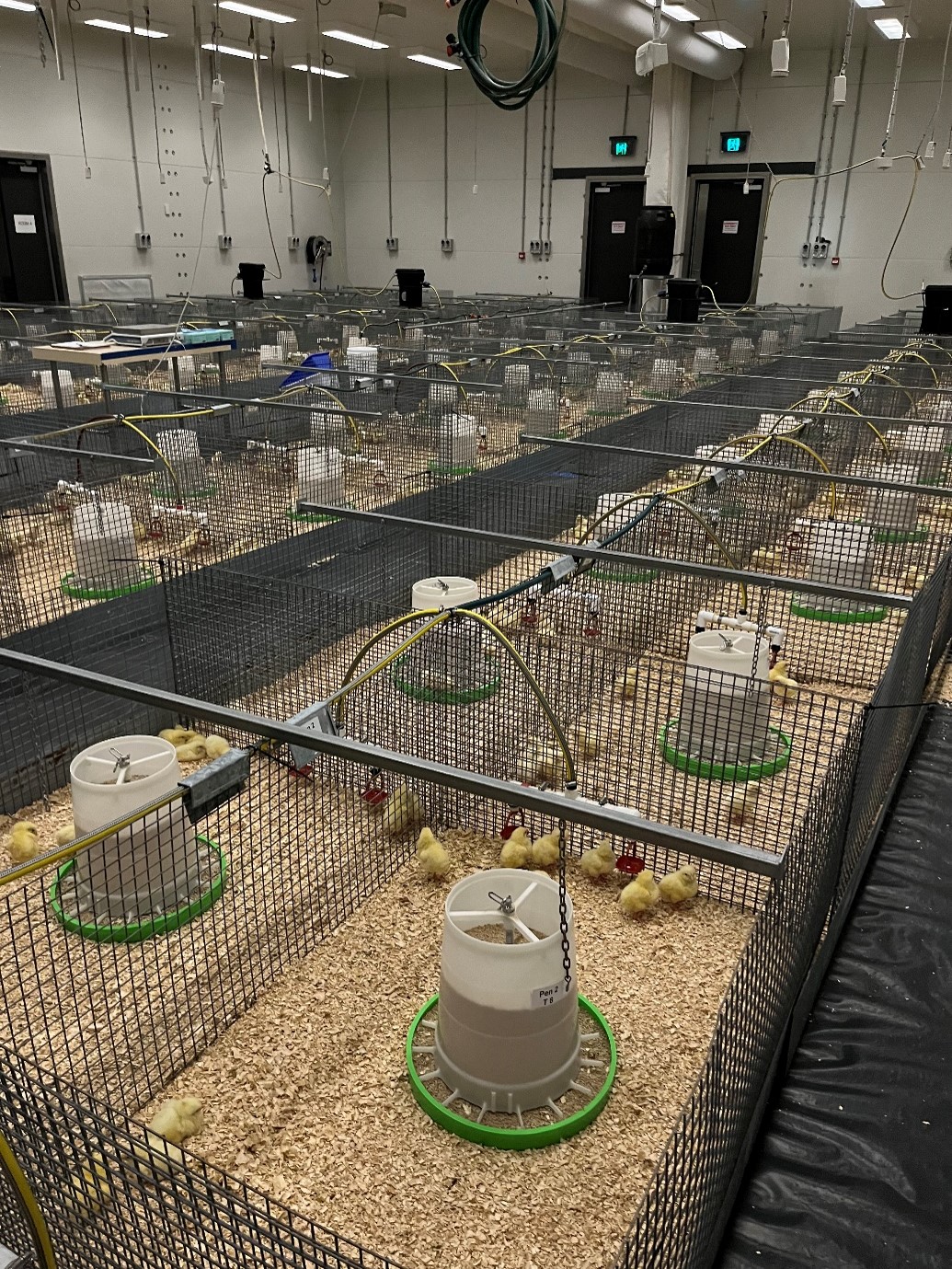
To systematically explore the complex, interacting effects of the three key nutritional factors; that is digestible lysine (dLys) as the reference EAA, the E:T ratio, and dietary energy, a Box-Behnken response surface design was utilised. This statistical approach allows simultaneous optimisation of three factors and their interactions, rather than exploring the factors in isolation. The choice of methodology matters precisely because broilers do not respond to nutrients in isolation: they respond to the most limiting constraint at a given time — whether energy, a specific EAA, or the broader amino acid balance. A conventional factorial design risks masking these interactions, whereas the response surface approach explores interactive effects rather than single-factor comparisons.
The aim was to identify the precise combination of energy, digestible lysine, and E:T ratio that maximises broiler performance while minimising abdominal fat content.
The premise was straightforward but important: performance in reduced protein diets is not restored by maximising one nutrient—it is restored by balancing both essential and non-essential amino acids.
Summary of Findings
Balanced nutrient supply supersedes single-nutrient maximisation
Optimal growth and feed intake were consistently achieved through nutrient balance, not by maximising any single nutrient in isolation. This finding challenges the common industry practice of pushing individual amino acid or energy levels to their upper limits without regard for the broader nutritional context. (AM3) (AM4)
Energy effects depend on amino acid sufficiency
At high E:T or lysine levels — where amino acid supply is sufficient — dietary energy exerted a similar impact on growth and feed intake. In other words, when amino acids are not limiting, energy becomes the primary driver of performance.
At lower E:T or lysine levels, a moderate reduction in dietary energy enhanced nitrogen utilisation and protein efficiency. This suggests that when amino acid supply is marginal, slightly reducing energy forces the bird to utilise available amino acids more efficiently — a metabolic adaptation with significant implications for both cost savings and environmental impact. However, excessive energy reduction at these lower amino acid levels impaired performance, indicating a threshold below which the bird cannot compensate.
Compensatory feeding behaviour
Broilers exhibited compensatory feeding to meet their most limiting nutrient, whether energy or amino acids. This behavioural response highlights the bird’s innate drive to balance its nutrient intake and explains why feed intake patterns can shift dramatically with changes in diet composition, whether with in energy and/or amino acid contents.
Oversupplying a single EAA can be harmful if energy or NEAA are not matched
Over-supplementation of individual EAA without corresponding adjustments to energy or NEAA negatively affected performance. This finding directly validates the project’s central hypothesis: that the E:T balance matters, and that simply adding more of a single EAA into an unbalanced diets can be counterproductive — even harmful. In other words, the diet can become “chemically adequate” for one amino acid yet functionally inadequate for growth because the overall metabolic network (including NEAA availability and energy) cannot utilise the surplus efficiently.
Take-home Message
Achieving optimal broiler performance, efficient nutrient utilisation, and minimal waste requires precisely balancing dietary energy with both essential and non-essential amino acids. The traditional approach of reducing crude protein and supplementing only EAA is insufficient. Instead, formulating on the basis of true protein (EAA + NEAA), maintaining an appropriate E:T ratio, and calibrating energy levels to the amino acid supply creates a nutritional environment in which the bird can express its genetic potential for growth while depositing less abdominal fat and excreting less nitrogen.