Game Birds
Game Birds
As the name implies, game birds are birds that are hunted in the wild, as well as kept in captivity where they are raised, often with some difficulty. They include guinea fowl, partridge, pheasants, squabs, and quail. Except for quail, they are seasonal breeders, so the product is not available fresh all year round. None are indigenous to Australia.
Partridge, although grown in small numbers, have not been included here, as it is not possible to get accurate information on numbers or farms. One Victorian breeder raises 2000 partridges each year for shoots. Also, some large producers and processors of other species (e.g. ducks) may also market quail, squabs, pheasants and guinea fowl under their own label but the product is often supplied from a game bird processor already packaged and frozen under the large producer’s own label. Pheasants and partridge are sometimes raised for shooting in Australia but information on these practices is difficult to obtain.
Some of the information reported here is based on surveys carried out by the Rural Industries Research and Development Council and published in 2003, 2005 and 2009 although much of the data are older.
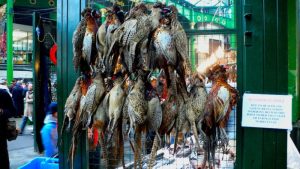
The production of game birds is labour-intensive and usually a family operation. There is often more than one game bird species grown on a game farm and most birds are processed at an independent, off-farm facility. The product is relatively expensive and is found mainly in gourmet restaurants, boutique butchers and occasionally in retail stores. The retail price for a 1 kg pheasant and 1 kg guinea fowl as of July 2009 was AUD $26.70. Demand is governed largely by economic conditions, however, demand has increased over the past 10 years and the most recent value of the industry is in excess of $20 million/year for game birds in total. Over half of this is for Japanese quail. Game bird meat generally has a ‘gamey flavour’ although this is an all-embracing term and varies depending on species and their diet. Formulated feeds for game birds are often the same as those for other domestic species such as turkeys and are changed according to the production phase.
Biosecurity on all poultry farms is of the highest priority. The Department of Agriculture, Fisheries and Forestry with Animal Health and the Poultry Industry has produced the ‘National Farm Biosecurity Manual-Poultry Production‘ which covers all farmed avian species and producers are expected to adhere to these guidelines. However, biosecurity on some game farms is minimal compared to the commercial poultry industry and visitors are sometimes welcome.
Guinea Fowl
Guinea fowl (Numida meleagris) is native to the more arid areas of the west coast of sub-Saharan Africa, but are currently found in India, and after chickens and ducks, are the most numerous poultry species there. They have featherless heads and the helmeted varieties are normally domesticated and often kept for ornamental purposes.
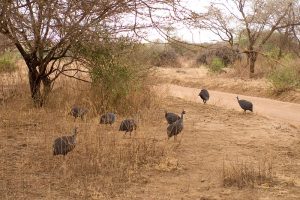
Guinea fowl like to be in small groups. There are three common varieties: pearl, lavender and white. The adults weigh over 1 kg. When about 35 weeks old, they start breeding in the spring with one male to five to eight females and are kept for up to three seasons or more. Average egg production is 55 to 100 per year, and each egg weighs 37 to 40 g. Guinea hens can be crossed with a domestic cockerel but the offspring are sterile. They are not good sitters and a domestic hen may be used instead of an artificial incubator at 37.2°C. Keets (chicks) hatch at 26 to 28 days and weigh 24 to 25 g and need artificial heat for up to 6 weeks. They are difficult to sex except by their call, but the adult male has a larger helmet and wattles. They are either free-range or housed and managed like meat chickens except for a more generous floor space of about 900 cm² per bird. They are ready to eat at 14 weeks with a dressed weight of 800 g to well over 1kg and conversion of feed to gain is about 4:1. The meat is very lean and breast meat yield is about 25% of live weight. One sensory evaluation indicated very little difference between chicken meat and guinea fowl meat. However, this may depend on the diet as there are reports of a ‘gamey’ flavour. Their meat is darker than chicken meat.
Little is known about their nutritional needs. There is debate as to how many diet formulations they should receive up to 8 weeks of age, and how much energy and protein should be contained in the diets.
Guinea Fowl Production in Australia
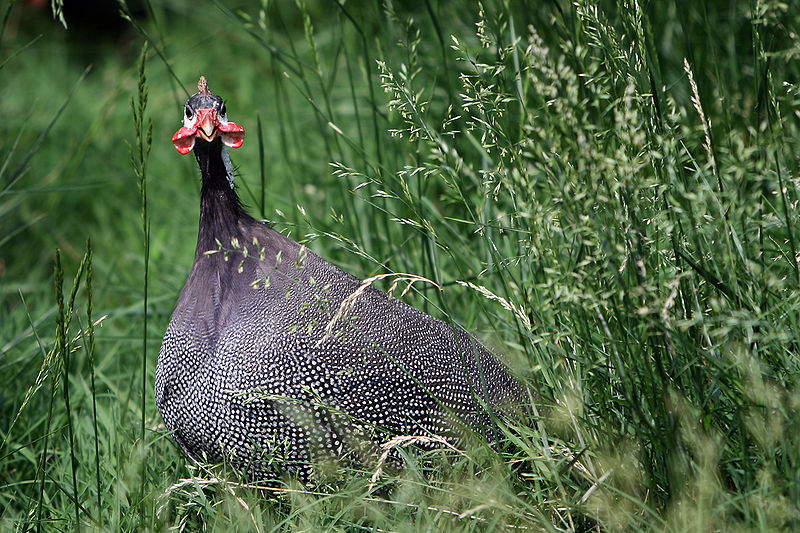
Helmeted Guinea Fowl - Photo courtesy of Wikimedia Commons
In Australia, there is a small guinea fowl market, which is likely to stay small. Production is less than 40,000 birds processed per year with an estimated market value of around $6.2 m. Guinea fowl can survive in the wild and in some areas they are such a nuisance that they have had to be culled. Hens lay about 50 to 60 eggs per year and hatchability is about 70% with a mortality of up to 15 %. Breeders (the lavender and pearl) are kept for 2 to 3 seasons and both adults and growing birds are generally allowed out-of-doors, although breeders are penned from September to January and sometimes for longer.
Keets are kept for about 6 weeks in pens with rice hulls or wood shavings for floor bedding. They are fed a pre-starter turkey diet which is changed to a turkey starter and grower diet as bird’s age. The guinea fowl are usually killed at about 20 weeks and often processed at an off-farm processing plant. Although dressed guinea fowl can be purchased fresh in season, they are usually frozen in weight categories that range from 850 g to 1.2 kg. Baby guinea fowl (400-600 g) and various carcass portions are also available. Demand is irregular, especially from restaurants, and as guinea fowl are not difficult to raise, opportunists enter the market from time to time thereby creating a glut. This does not encourage the established guinea fowl producers to expand their operation. Some producers often keep other game birds such as partridge and pheasants. Fly fishermen purchase feathers for tying flies for fishing.
Bio-security is not a high priority. Olson Game Birds at Swan Hill, Victoria, for example, caters for tourists and has a number of attractions including a restaurant. They promote their farming practices of game birds (guinea fowl, pheasants and partridges) to be ‘according to strict organic principles’.
Pheasant
It is believed that pheasants were introduced into Europe from China in about 1300 BC. They were brought to Britain in 1050 AD and transported to the United States in the 18th century. Pheasants are often raised for autumn and winter shoots, particularly in the United States, the United Kingdom and some European countries, especially those in Eastern Europe. It is an expensive sport and membership of a shooting syndicate in the UK may exceed ten thousand dollars per season, but this may also include generous hospitality before and after the shoot. Part of the reason for this high cost is that pheasants grow slowly and are expensive to raise. Although not native to these regions, the ringneck pheasant (Phasianus colchicus) is still found in the wild, in part because some of those raised for shooting will escape.
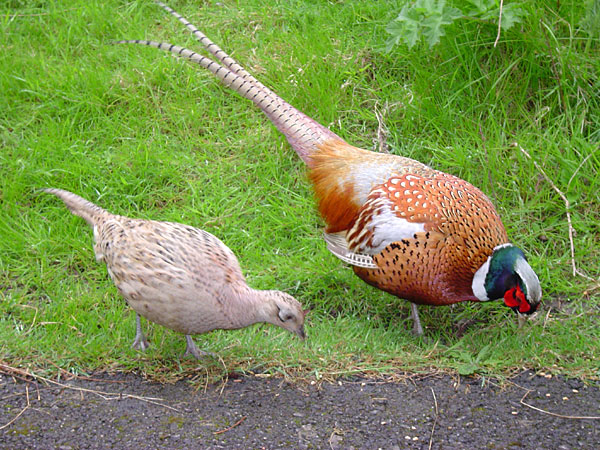
A male and female Pheasant. Photo courtesy of Wikimedia Commons
Pheasant Production in Australia
There are very few commercial pheasant farms in Australia and information on farming practice is scarce. It is estimated that 60,000 pheasants are processed annually, creating a market of $1.26 million per year. Pheasants, in pens of 40 to 50, are mated about four weeks before the breeding season starts.
They lay from October to January for two seasons although the rate of lay is lower in the second season and production peaks in November. Average egg numbers per hen are about 50–60 per season. The eggs are incubated for 24 days and brooded for at least three weeks depending on the weather. They are then kept in enclosures each of about 60 poults with access to a grassed pen at around 4 weeks of age. Early mortality at three to five days is usually due to chicks not eating (starve outs). Some common diseases encountered include rotavirus, coccidiosis and gapeworm, particularly if the pasture is not rotated.
Disease outbreaks may depend on weather conditions but a coccidiostat is usually incorporated in the early diets. The chicks are first given a very high protein, crumbled diet (27% crude protein, CP). At 14 days this is replaced by a small pellet (23% CP) to 28 days, then a poult pellet (20% CP) to slaughter age. These diet specifications more or less correspond to those of turkeys, so turkey diets are often fed to pheasants. Feed conversion is approximately 4.5 kg of feed per kg of live weight gain. During the egg laying season, pheasants are given a breeder diet which is then changed to a mainly all grain maintenance diet in February.
Pheasants are killed at 16 to 18 weeks and at a weight that yields a dressed carcass of about 1 to 1.5 kg. Only first season pheasants are used for whole bird sales and the two-year-old birds are processed into sausages. Their meat is a little on the dry side as pheasant meat has little fat, but this can be altered depending on the recipe and cooking method.
Japanese Quail
Japanese quail Coturnix japonica is a subspecies of Coturnix coturnix. They were domesticated in China, which is now the world’s largest producer of quail meat (160,000 tonnes of meat per year). Far behind are Spain and France with 9,200 and 8,100 tonnes respectively. It is only recently that quail were farmed widely for their eggs and meat. Some strains grow very rapidly, reaching 300 g in less than 4 weeks and egg production can reach over 250 in a year. They start to lay at 5-6 weeks of age but they do not incubate their eggs (10 g) and they are placed in an artificial incubator set at 37.5 °C with high humidity of 70%. Eggs will hatch at 17-18 days and the chicks are only 6-7g, which is little larger than a bumblebee. The ratio of males to females is 3 to 5:1 for breeding. There are distinct differences between the feather colour of the sexes and the females are larger than the males. The chicks are brooded with heat lamps for 3-4 weeks and are sometimes beak trimmed at two weeks with nail clippers to prevent cannibalism. The floor is solid with sand, sawdust or shavings and feed is spread on coarse paper during week 1 to encourage eating. Growing quail are then housed in group cages, generally with mesh wire (7 m²) floors and each quail allocated 125 cm² of floor space. They reach maturity at 6-7 weeks. There is more known about management, nutrient requirements and wellbeing of quail than that of other game birds.
Quail meat, particularly the breast fillet, is very lean. There are also reports that after lay, the adult bird has meat that is acceptable. The eggs, though small, are a delicacy and sometimes pickled. It is not unusual to find whole eggs, hard-boiled, floating in soup dishes in some Asian cuisine.
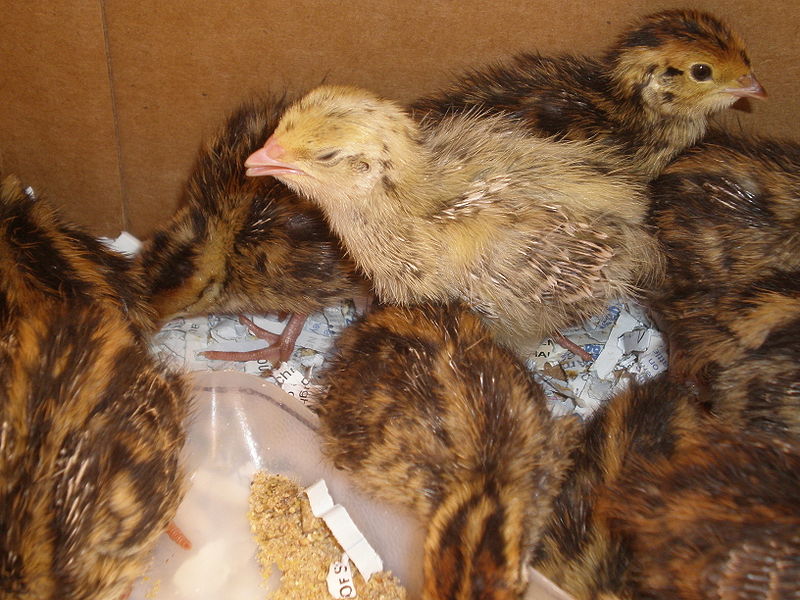
One week old Quail chicks. Photo Courtesy of Wikimedia Commons
Japanese Quail Production in Australia
This is the largest game bird industry in Australia. Recent figures are 6.5 million quail processed annually, worth $14 m. The largest producer has 75-80% of the market and has been expanding steadily. They have outside contract quail growers and also process pheasants and guinea fowl for independent growers. There are at least nine other small commercial quail farmers in New South Wales, Queensland, Tasmania and South Australia. Quail exports are valued at about $400,000/year
Quail meat is popular and a dressed quail weighs 180 to 200 g. Initially, immigrants were the main customers but this has now changed and there is a much wider consumer base including restaurants, gourmet butchers, airlines, the major supermarkets, five-star hotels and wholesalers, especially those in the Asian markets.
There is a market for quail eggs which are sold to wholesalers in bulk and some are sold directly to retail outlets in cartons. Stubble Quail (Coturnix pectoralis) are hunted in the wild during open seasons which are determined by Government authorities. These may be in the autumn or split between the late summer and early winter.
Breeding quail are housed in cages each holding about 25 birds in a climate-controlled large shed. Lighting is maintained at about 16 hours per day but much less when quail are grown for meat production. The fragile, mottled brown eggs roll out of the cage on to a tray for collection. Egg type incubators, with modified egg trays, are normally used. Chicks are brooded at a temperature that is adjusted according to bird behaviour. Aspergillum can be a problem in the first three weeks, and although quail are hardy they are usually vaccinated against Salmonella typhimurium and medication is used to control coccidiosis and enteritis.
Because quail are raised indoors, strict biosecurity measures can be implemented without great difficulty.
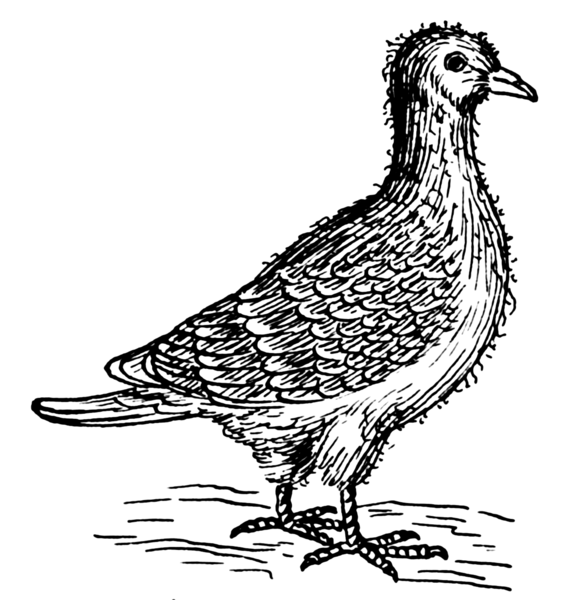
Egyptian farmers raise more than 70% of the squabs on a global basis. Photo courtesy of Wikimedia Commons
Squab
Domesticated pigeons (Columbia livia domesticia) are raised for racing and ornamental purposes and for meat production mainly as young birds (squabs). The ancient Egyptians were one of the first to produce squabs for the table and this practice spread to Rome and Medieval Europe. Today, Egyptian farmers raise more than 70% of the squabs on a global basis.
They grow at a rapid rate and have a prodigious appetite, and depend on their parents to provide nourishment in the form of ‘crop milk’ which is stimulated by the hormone prolactin (as is also done by some other avian species such as some flamingos and penguins). The composition of the milk changes as the squab ages. Initially, it is high in fat and protein with high levels of the essential amino acids. Production of crop milk declines and ceases in the female earlier than in the male which allows her to lay two more eggs and to incubate them, assisted by the male.
Eggs will hatch at 17 days. In a breeding season, which is September to January, one pair of pigeons will produce 12 to 15 squabs, each weighing about 500 g at 24 to 28 days of age when lactation has already ceased and they have full feather cover. Dressing out is about 350 g, although this will vary with the breed. The meat is dark in colour and similar to that of duck meat.
Squab Production in Australia
The industry has grown from about $6.2 million in 2002 ( 680,000 squab/year processed) to close to $11 million today. There is an Australian Poultry Squab Producers Federation which has members in most of the states. These family-run farms typically have 500 to 1500 breeding pairs, which produce 6,000 to 12,000 squabs per year. Some rely on outside processing plants to process their squabs and others rely on other game bird producers to market their already processed squabs. They are held in breeding pens or lofts with wire mesh or solid floors with wood shavings and holding 20 to 30 pairs. The pen is either closed or with an open flight area depending on the climate. They are best suited to dry, temperate conditions. There are two raised nest boxes per pair to accommodate the two squabs still being fed and this also allows for the hen to incubate her eggs for the next hatch.
Pigeons are housed according to age. Young birds of similar age are kept together, as are first time breeders.
There are several different breeds, which are often crossbreeds, used for squab farming but the White King (750 to 850 g) crosses from the United States are the most favoured. The slightly smaller Red Carneaux from France is also used in breeding programs. Breeding pigeons are left to their own devices when it comes to nest building and pine needles, straw or wood shavings are left in a pile in a rack. Pigeons are sexually mature at about seven to eight months. The female will breed for approximately eight years and the male for five years. Pigeons are usually given a choice of grains, legume seeds such as peas and whole or oil-extracted oil seeds with access to grit and minerals and vitamins. As their nutrient needs will vary with the stage of lactation and when incubating eggs, the birds will alter their selection of feed ingredients. Some producers feed their pigeons a formulated, pelleted diet with whole-grain available separately.
It takes about 3 kg of feed for parents to grow one squab to 500 g. As crop milk is initially very high in water, pigeons need about one litre per day for five birds and there should also be water separately for bathing. Some producers maintain that crop milk produced by the lactating pair for no more than 10 days and that the parents then regurgitate grain to feed the squabs. The squabs are sent to the processing plant at about 28 to 32 days and dress out at 200 to 500 g. The price of grains has risen to the extent that few new farmers are now entering the business, which is only marginally profitable, although there is no shortage of consumer demand, mainly from the Asian population. Chinese and French restaurants are the main customers and squabs can be bought in some farmers’ markets.
Provided the pens are kept dry and clean and management is of a high standard, bird health should not be a problem. Weak and unhealthy birds should be removed immediately. However, the roundworm, Ascaridia Galli, is a common internal parasite, and lice and red mites are external parasites in pigeons. Chronic respiratory disease, pigeon pox and coccidiosis are sometimes seen in birds. The silkiness of feathers is an external indicator of peak bird health.
Information kindly provided by Dr David Farrell
You May Also Like


The Poultry Hub Australia profoundly acknowledges and respects that its foundations, both people and facilities, are established on land rich in the history and traditions of the world’s oldest living culture. PHA values and respects Indigenous knowledge, understanding its importance in our shared history. We acknowledge the strength, resilience, and contributions of the Aboriginal community, we pay our tributes to the Aboriginal Elders – those who guided us in the past, those who lead us today, and those who will enlighten our paths in the future.