Chicken
Chicken
Domesticated over 7400 years ago, the chicken belongs to the Galliformes order and is believed to have originated from the red junglefowl (Gallus gallus) with some hybridisation with the grey junglefowl (Gallus sonneratii).
Ancestry: the jungle fowl
Jungle fowl are predominantly ground-dwelling birds living in areas with dense overhead vegetation. Social groups typically consist of one male with up to four females and their chicks, although larger groups of up to 20 birds can form in more open environments. Other males are either solitary or form unisexual groups of two or three birds. Family groups have a well-defined home range and a regular roosting location.
Flocks spend the majority of the day on the ground and generally only roost at night or in response to perceived danger. Foraging for food comprises up to 75% of their activity during the day. Maintaining plumage condition through preening and dust-bathing is also a consistent daily activity as the dust absorbs extra oil and subsequently falls off. The breeding season varies but is generally in the spring and summer in temperate zones, where breeding is stimulated by increasing day length and halted by decreasing day length in autumn. Breeding is all year round in tropical areas.
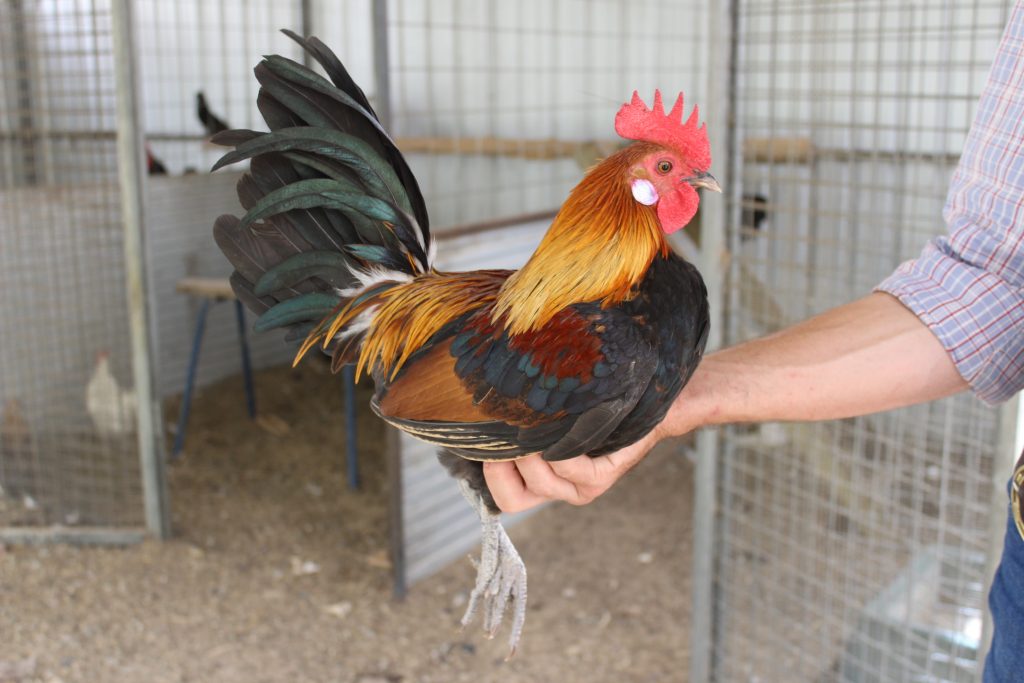
Red Jungle Fowl
Jungle fowl are ground layers, hens select a nest site that is a well-concealed hollow that may or may not be lined with grass or leaves. They lay a “clutch” (a set of eggs produced or incubated at one time) of five to eight eggs. They then become broody (physiologically ready to incubate eggs after having completed egg-laying) and sit on the eggs to incubate them. Hens cease to be broody and drive the chicks away when they are six to eight weeks old.
Observations of the behaviour of jungle fowl are useful in understanding the underlying behavioural drives of domestic chickens, however, it has not been satisfactorily quantified how much domestication may have modified these drives. By comparison, domestic chickens are less active, have fewer social interactions, are less aggressive to would-be predators, and are less likely to go looking for foreign food sources than their wild ancestors. As a result of global spread and domestication, a large number of breeds of the domestic chicken (Gallus gallus domesticus) have been developed.
Since the red jungle fowl still exists in its wild state today, it is possible to compare the characteristics of the domesticated chicken with its wild ancestor. Physical changes that have resulted from domestication include increased growth rate and adult body weight, simplified plumage, earlier sexual maturity, more frequent egg-laying and larger eggs. Originally found in parts of China, India, Malaysia and Indonesia, the red junglefowl has contributed the majority of the genes to the domesticated fowl. However, recent research suggests that the Grey Junglefowl (Gallus sonneratii) also made a small contribution. Earliest domestication, some ten thousand years ago, was in India and Vietnam when the junglefowl was kept for their meat and eggs. It is doubtful if there are any of this species remaining in its pure form. There are four subspecies of the red junglefowl: the Javan, the Cochin Chinese, the Burman and the Tonkinese. The hen and the cock weigh only about 500g and 1100g respectively.
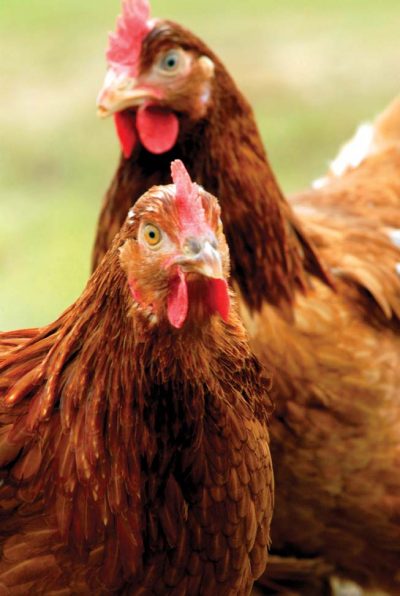
Modern Layer Hens
Today: pure breeds and industry hybrids
A breed can be defined as a group of fowls that reproduce their own likeness in their offspring, that is, the offspring share a defined set of characteristics with the parents. In some breeds, there are differences in one or two characteristics, for example, in comb shape or feather colour. These different types within a breed are varieties, for example, white and brown leghorns, which are well recognised varieties of the leghorn breed.
There are many breeds of fowl, but only a small number are used to breed the commercial birds that most poultry farmers use. In commercial poultry production, in many parts of the world, there are two types of bird, an egg type and a meat type, with a number of breeds within each type. The egg type (or layers) and the meat type (or broilers) both produce eggs and meat, the difference is in how efficiently they produce these commodities. These types are derived from the more traditional breeds that have been combined in different ways and selected for particular characteristics over a number of generations to end up with the commercial layer or broiler. A useful analogy may be seen in cattle, where specialist dairy and meat breeds have been developed over centuries through selective breeding. As is the case with cattle, selection for the improvement of the economically important characteristics is an ongoing activity in poultry breeding programs.
As the commercial poultry industry relies on only a few poultry breeds to produce their hybrid broilers and layers, there is a significant risk that many pure breeds may disappear. Had it not been for the dedication of the stud breeders, this would certainly have happened. The formation of clubs, poultry exhibitions and shows; the rigorous maintenance of standards and their enthusiasm, have all contributed to an expanding group of poultry fanciers. There are about 300 poultry clubs in Australia representing thousands of poultry keepers.
In the past, many Australian families owned their own flock of hens to supply them with meat and eggs. Today, in Australia, most chicken meat production is carried out as an intensive livestock enterprise by commercial producers. The Australian chicken meat and egg industries are separate industries that use different chicken breeds, housing and production systems.
The chicken meat industry produces meat and uses a different type or breed of chicken than that used for egg production. Some meat-type breeds can produce over 1 kg of live weight from less than 2 kg of feed. Strains of chickens bred for meat production are called meat chickens. The word broiler is an American term for meat-producing birds which is not commonly used in Australia outside of the poultry industry because it can be confused with boiler, which in Australia means an old or spent hen that has finished its productive life as a layer. A dressed fowl is one that has been killed, plucked, and had its feet, neck and internal organs removed. The term is derived from the bird being ‘dressed up’ to go to market.
The chicken layer industry produces intact eggs for humans to eat, called table eggs, and other egg products, such as egg pulp or liquid eggs, for use in cake mixes and other food products. Layer strains of chickens may produce over 350 eggs each year. As chickens lay eggs ranging from very pale cream to brown, layer strains have been selected to suit the preferences of consumers in particular countries. Australians tend to favour brown eggs, which accounts for the use of mostly brown egg-laying hens in the Australian layer industry.
You May Also Like

The Poultry Hub Australia profoundly acknowledges and respects that its foundations, both people and facilities, are established on land rich in the history and traditions of the world’s oldest living culture. PHA values and respects Indigenous knowledge, understanding its importance in our shared history. We acknowledge the strength, resilience, and contributions of the Aboriginal community, we pay our tributes to the Aboriginal Elders – those who guided us in the past, those who lead us today, and those who will enlighten our paths in the future.