Coccidiosis
Coccidiosis
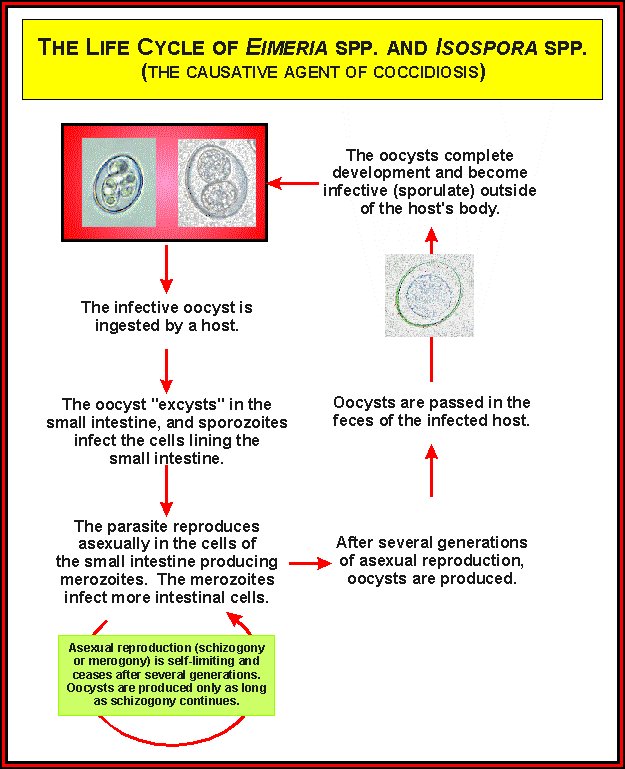
Eimeria lifecycle (Source: Beagles Unlimited.com)
Coccidiosis is one of the most common and economically important diseases of chickens worldwide. It is caused by a parasitic organism that damages the host’s intestinal system, causing loss of production, morbidity and death. This disease has a major economic impact on the global poultry industry.
Coccidia life-cycle
Coccidial parasites are protozoa belonging to the phylum Apicomplexa. Chicken coccidiosis is caused by seven species, all from the genus Eimeria: E. acervulina, E. brunetti, E, maxima, E. mitis, E. necatrix, E. praecox and/or E. tenella. The life-cycles of these species are direct. Chickens ingest sporulated oocysts (the parasite ‘egg’) from contaminated litter, and these pass into the intestinal tract, where the parasites invade the cells of the intestinal wall. Several cycles of replication occur which lead to the formation of new oocysts which are shed in the faeces. Depending on environmental conditions (including temperature and humidity), the oocysts sporulate and become infective. The entire cycle takes 4 to 6 days. This short, direct, life-cycle combined with the potential for massive replication during the intracellular phase, makes this group of parasites a serious problem under intensive farming conditions.
Intestinal damage
The following photos show intestinal damage caused by various species of Eimeria in chickens. Source: The Merck Veterinary Manual
 |

|

|

|
It is the replicative phases of the parasite which lead to damage in the intestinal tissues. Individual birds may show no clinical signs or may suffer a mild loss of appetite, weight loss or decreased weight gain, diarrhoea (which can be bloody), dehydration and death. Resistance develops rapidly and infections can be self-limiting, but naïve birds which consume large numbers of oocysts can be severely affected and die. Immunity is strictly species-specific which means that birds exposed to one Eimeria remain susceptible to infection from all other species. The degree of injury caused by the seven species varies, with some developing deep in the intestinal mucosa, causing wide-spread damage and distinct gross lesions (e.g., E. tenella). Other species are less destructive but may still have a significant impact on production. All species are potentially of importance economically.
The following diagrams show the intestinal sites parasitised by various species of Eimeria in chickens. Source: The Merck Veterinary Manual

E. acervulina |

E. brunetti |

E. maxima |

E. mitis |

E. necatrix |

E. praecox |

E. tenella |
Methods of Control
Eimeria are present world-wide, and are ubiquitous under intensive farming methods. Up to six species have been shown to occur simultaneously on one farm. The omni-present nature of Eimeria precludes eradication as a practical option for control. Since species-specific immunity develops rapidly, the management of coccidiosis aims to achieve a balance between allowing natural immunity to build up and preventing high oocyst exposure to naïve birds. Hygiene, anticoccidial drugs and vaccines all play major roles.

Hygiene
As species of Eimeria have direct life-cycles, mechanical transmission is the primary means of spread between farms and between sheds on a farm. Oocysts are resistant in the environment, both to climatic extremes and disinfectants, and can survive for weeks in soil. However, they only last for days in litter due to heat caused by fermentation and the presence of ammonia. Good hygiene, such as cleaning boots and exchanging clothes between sheds, and the eradication of rodents, assists in minimizing the transmission of oocysts. Effective farm management, such as well maintained, drip-free water lines, minimize the level of infective oocysts in the litter, as desiccation significantly reduces sporulation.
Anticoccidial Drugs
Chemotherapy has been the main approach for controlling coccidiosis in chickens. Anti-coccidial drugs are usually used preventatively and if a farmer were to wait for overt signs of disease before treating the flock, morbidity and mortality would be high and the economic damage already done. Almost all commercial, intensively farmed flocks are administered anti-coccidial drugs prophylactically. When given at the correct low preventative doses, Eimeria species are able to complete their life-cycles without large numbers of infective oocysts building up in the environment. Such subclinical infections result in the development of strong, specific natural immunity without overt disease.
Vaccination

Live, virulent vaccines have been utilized since the 1960s and live attenuated vaccines have become available since the 1980s. The attenuated strains have been selected for rapid passage through the host. Consequently, they have low reproductive potential and have lost their virulence, but still have strong immunogenicity. Importantly, they cause no post-vaccinal decrease in weight gain and are therefore suitable for use in broiler flocks.
Further information
- McDougald, LR (2003) Protozoal Infections. In: Diseases of Poultry (ed. Saif YM), Iowa State Press, pp. 973-1026
- Trees, AJ (2002) Parasitic Diseases. In: Poultry Diseases (eds Jordan, F; Pattison, M; Alexander, D; Faragher, T), W.B. Saunders, pp. 405 – 436
You May Also Like


The Poultry Hub Australia profoundly acknowledges and respects that its foundations, both people and facilities, are established on land rich in the history and traditions of the world’s oldest living culture. PHA values and respects Indigenous knowledge, understanding its importance in our shared history. We acknowledge the strength, resilience, and contributions of the Aboriginal community, we pay our tributes to the Aboriginal Elders – those who guided us in the past, those who lead us today, and those who will enlighten our paths in the future.