Goose
Goose
There are almost 60 distinct breeds of geese and many of these are found in Eastern Europe. Geese were first domesticated in China over 6000 years ago and were domesticated over 3000 years ago by the Egyptians. They belong to the genus Anser and are descendants of the wild swan goose Anser cygnoides, which is found mainly in Asia, and the greylag goose (Anser anser). The most common commercial breeds are the White Embden, Grey Toulouse, the African, the small White Chinese and Brown Chinese. The small White and Brown Chinese goose only weighs 4.5 to 5.5 kg, but they lay about 100 eggs per season and are popular in Southeast Asia. Chinese geese, unlike European geese, have a large knob at the base of the bill.
They are farmed for their meat, feathers and down and to produce fatty livers (goose meat is also notoriously fat). Eggs hatch within 30 to 35 days depending on breed. Ninety-four per cent of the 2.5 million tonnes of goose meat consumed annually worldwide is produced in China (from many different breeds), followed by Ukraine, Egypt and Hungary. Only 900 tonnes are produced in the US.
Global goose meat production was around 2.5 million tonnes in 2010, this accounts for 2.6 % of world poultry meat production. China is the largest goose meat producer with an annual production of around 2.41 million tonnes in 2010.
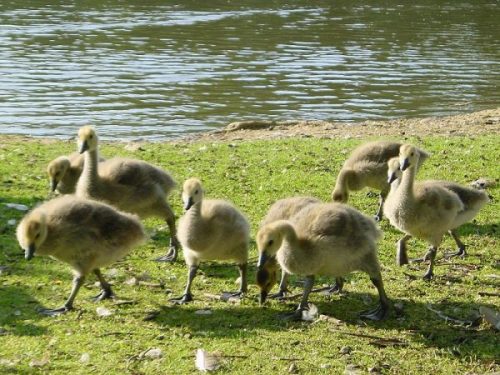
Goslings
Production
Geese prefer to mate on water and the gander should be run with females for a month prior to the start of the breeding season. Generally, they come into lay at 40 to 50 weeks of age and lay only 30 to 45 eggs (weighing 120–170 g) with low fertility and hatchability giving 60 goslings/100 eggs set, depending on breed. A moderate feed restriction for about two months prior to lay increases gosling numbers. The goslings grow very rapidly so that they may reach 2 kg at 4 to 5 weeks of age but are not fully mature until two years old.
Geese are usually disease-free, hardy, have long lives and can exist by foraging and without supplementary feed. Although this is thought to be due to their capacity to digest fibre in the diet, it is, in fact, their ability to extract protein from the herbage that they forage. They are farmed in small groups with one gander to about four females. They may be kept on free-range or in pens with slatted floors or on straw bedding.
Goose Production in Australia
Gaggles of geese can be seen in many parts of the country, apparently in an unmanaged, nomadic state but usually close to water. About 5,000 young geese (goslings) were killed in 2002 yielding 20 tonnes of meat with a retail value of $400,000. It is therefore very much a backyard rather than a commercial industry and preference is for white-feathered breeds such as the Embden. A gosling of 2.5 to 4.0 kg dressed weight retailed for $22.9/kg in 2009. There is at least one farm in North Central Victoria which supplies goslings to a retail outlet in Bendigo and another Victorian processor cannot get sufficient goslings to meet demand, particularly at Christmas and Easter time. In 2007, there were seven abattoirs that claimed to process geese.
Small gaggles of about 12 females, each laying 10 to 15 eggs in the spring and again in January, raise 12 to 20 goslings per season. These may be kept by grain farmers as a sideline business looking to increase their income. The geese may be confined to pens but are more likely allowed to range on special pasture such as lucerne. For best results, the goslings are separated from the goose at six to eight weeks of age when brooding is no longer needed, and then hand-reared on expensive, concentrated feed. Muscovy ducks are sometimes used to hatch 6 to 8 goose eggs, thus allowing the goose to concentrate on laying more eggs. Increases in immigration to Australia of populations that traditionally consume goose meat (e.g. China, Poland), have increased the need for more organised geese production. Lack of a consistent supply of goose meat is a drawback and the genotypes now available in Australia are unlikely to form the basis of a viable, commercial goose industry. There is a need to import superior breeds available in countries with established goose industries, such as France and Eastern Europe.
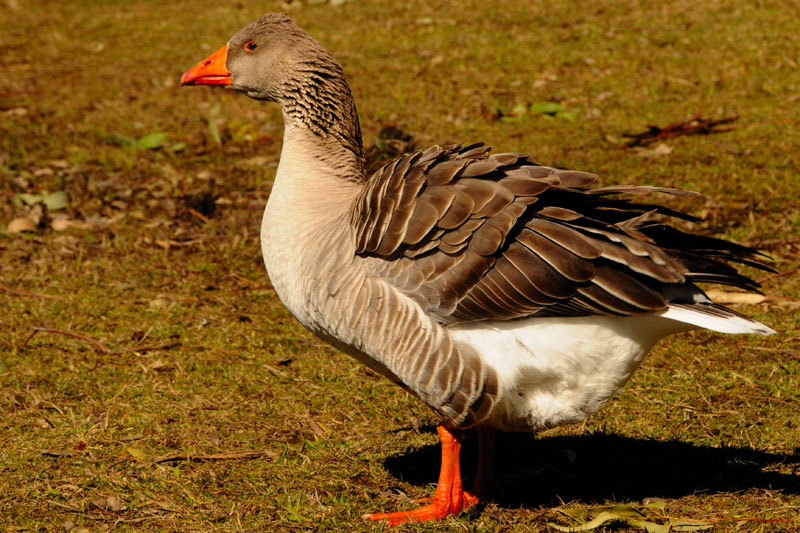
A goose near Armidale, NSW
Other uses for geese
Geese are very versatile. They were once used in the US for controlling weeds in several crops (asparagus, tobacco, beans, potatoes) and the water hyacinth from overtaking waterways. They also serve as guard dogs.
Ballantine’s whisky bonded warehouse near Glasgow is guarded by geese.
After China, Hungary is the largest producer of down and feathers. The geese are plucked three times a year yielding up to 350–400g down and feathers/bird.
Geese are also farmed for their livers which are used to produce foie gras. The liver weighs from 500 to 800 g, and are usually fattened for production via force-feeding. The geese are mainly fed grain for about two weeks when the goslings are from nine to twenty weeks of age. Force-feeding both geese and ducks is banned on welfare grounds in Australia and in many countries, particularly in the European Community. However, force-feeding was practiced in ancient Egypt and is the current preferred practice in France, where the majority of foie gras is produced and consumed. Hungary is a major producer and most is exported to France.
You May Also Like


The Poultry Hub Australia profoundly acknowledges and respects that its foundations, both people and facilities, are established on land rich in the history and traditions of the world’s oldest living culture. PHA values and respects Indigenous knowledge, understanding its importance in our shared history. We acknowledge the strength, resilience, and contributions of the Aboriginal community, we pay our tributes to the Aboriginal Elders – those who guided us in the past, those who lead us today, and those who will enlighten our paths in the future.